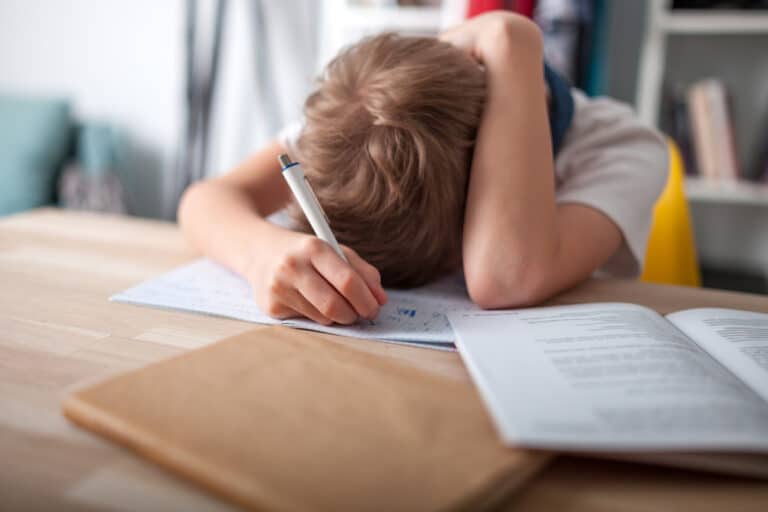
Imagine your child sitting in class, waiting for a test to begin. Inside their head, they’re running through all the information they’re trying to remember, and a thought creeps in:
“What if I’m not smart enough?”
And then another, “Tommy said I can’t be good at math because I’m a girl.”
And then another, “What happens if I fail the test?”
And then another and another until your child has created an ongoing inner monologue of worry.
The more a child worries, the worse they perform. Anxiety is very common among children with learning challenges. It can occur not just before a test, but when your child is faced with interacting with new classmates, studying a difficult lesson, or even simply having to go to school. It is one of the biggest contributing factors in faltering under pressure in academics, and why you often see bright and talented students still fail tests, classes, or whole grades, or freeze under pressure right when their big moment is upon them.
Today, we’re going to examine what’s happening inside the mind when anxiety occurs, and I’ll share my suggestions on how to help your child stay calm and collected in the classroom.
First, let me say that I am not a neurologist or an expert on neurology. I am an Educational Therapist who has hands-on experience with children and the brain in the learning process. The information I am sharing comes from my professional experience as an educator and ET, as well as from my own evidence-based research.
Now, let’s take a look at what is happening internally when your child becomes anxious. According to psychologist Mark Ashcroft, anxiety occurs when the brain power of the working memory is diverted away from the task at hand.
Working memory is our short-term or recent memory, a system for temporarily storing and managing the data needed to carry out complex cognitive tasks such as learning, reasoning, and comprehension. It’s involved in the selection, initiation, and termination of information processing functions such as encoding, storing, and retrieving data.

That’s a mouthful, huh?
In plain speak, it’s the whiteboard at the front of your brain, your prefrontal cortex, where you keep track of the stuff you need to remember for the short term. When you’re done with it, you clean the board to make room for new information. So when that stressful test or lesson is presented, the child who is anxious is not focusing on the relevant data needed to be successful, but rather they are distracted by all the anxious thoughts and feelings.
But where does the stress come from? Dr. Sian Beilock, an expert on performance and brain science, believes the root of worry comes from stereotypes in society, like “The dumb blonde,” “Athletes don’t like school,” etc. These stereotypes preoccupy the mind of the student, regardless of whether the statement is true or not, and regardless of whether the person thinking it believes it’s true or not.
Even a seemingly positive stereotype can have negative effects. Let’s use, for example, the stereotype, “All Asians are good at math.” But what if I’m Asian, and I’m not good at math? Anxiety may cause the child experiencing anxiety to focus on the thought, “Oh no, I’m going to be found out; there’s something wrong with me because I can’t do this well.” This benefits no one and, of course, allows no room for success at math.
Any of these thoughts can divert a student’s attention away from the task at hand, away from working memory, and cause them to “choke” on the assignment or test.
So, poor performance isn’t always tied to a lack of knowledge, but rather to this thought or thoughts that the student cannot let go of which is taking up space in their mind.
And, it can be a conscious or unconscious experience for them.
Here are some strategies and tips to begin unraveling your child’s experience of anxiety and set them off on a more calming path.
1] Cognitive Outsourcing involves using an external memory source that’s free from worry to store the information needed for the task. It’s as simple as a piece of paper. At the start of the test time, your child will write down on a piece of scrap paper or on the test itself the information that they will need, so they won’t have to continue to retrieve it during the test. For example, their times tables or spelling rules like “i before e except after c”.
2] Utilize mnemonic devices or acronyms to help your child commit larger chunks of information into their long-term memory in a way that increases the chance they can recall it when needed.
3] Reframe the body’s response to stress or worry as positive. Practice noticing when the physical symptoms of anxiety – heart racing, sweaty palms, perspiration – occur, and then put a positive spin on them, such as, “Oh, this is just my body trying to take care of me.”
4] Affirm your child’s strengths and personal value. If your child is struggling in math, affirm their strong work ethic toward solving the problem and celebrate how they have improved.
5] Practice under pressure. Many parents shy away from timing their children during practice tests, but I recommend it. It will help your child become comfortable with what will happen in the classroom when they are in the testing arena, and so they can practice their responses to worry in a low-stress environment.
6] Encourage your child to write about the pressure they’re feeling, in real time. Free writing is a powerful tool to release anxious energy from the body, so that they can concentrate on the task at hand.
7] Put the situation into context. Your child does not yet have the ability to see around corners to what’s ahead, so this challenge needs context from someone older and more experienced in life, YOU! Remind them that this test, class, project, school year, etc., is just one experience among many that they’ll have. It will be over soon, and they will move on to something else. Will this one test really matter to them in a month? How about in a year? In five years? Perspective grounded in reality is key to calming anxious thoughts.
8] Try meditation. It doesn’t need to be a big show, even 2 minutes of focus on the breath is a powerful method for clearing the mind.
9] Discover real-life role models who exemplify success and defy the stereotypes that are at the root of the anxiety. Post pictures of these people as visual reminders for when times get tough.
I hope these strategies help you and your child work through their anxiety and create a calmer classroom experience. For further reading on this concept, I recommend Dr. Beilock’s book “Choke: What the Secrets of the Brain Reveal About Getting It Right When You Have To.”
Is your child struggling with anxiety in the classroom?
What strategies have you found effective to help him or her regain their focus and complete their tasks? Let me know in the comments below.